Workflows
Stop Making GPT-5.6 Sol Do Everything
Sol is most useful as the control plane: plan the work, dispatch bounded tasks, review the evidence, and step back in when judgment becomes the job.
Use this when
you want to make the work cheaper.
Learn how to use GPT-5.6 Sol for planning, dispatch, orchestration, review, and escalation while routing bounded execution to Terra or Luna.
Key takeaways
- Use Sol for ambiguity, decomposition, architecture, final review, and escalation.
- Give Terra bounded work that still needs reasoning and tools. Give Luna explicit, repeatable transformations.
- A worker is not ready until the outcome, boundaries, checks, evidence, and escalation rule are explicit.
- Measure accepted work, retries, review time, and Sol escalations before claiming that routing saves usage.
The problem is the job, not Sol
I've seen people on X complain about Sol eating their usage. My experience has been anything but that.
The difference is not a secret setting. It is the job I give it.
If Sol plans the work, edits every file, runs every test, reads every log, fixes every typo, and then reviews itself, of course it spends. You hired the most expensive person in the room and made them carry boxes between meetings.
I use Sol as the control plane. It figures out what matters, breaks the work into pieces, decides what can be safely delegated, reviews the evidence, and steps back in when a worker hits something genuinely hard. The mechanical work happens somewhere else.
I do not have a clean percentage-saving benchmark yet, so I am not going to invent one. What I can say is that my useful Sol sessions do not feel usage-starved when its context is protected from execution churn.
OpenAI already gave the models different jobs
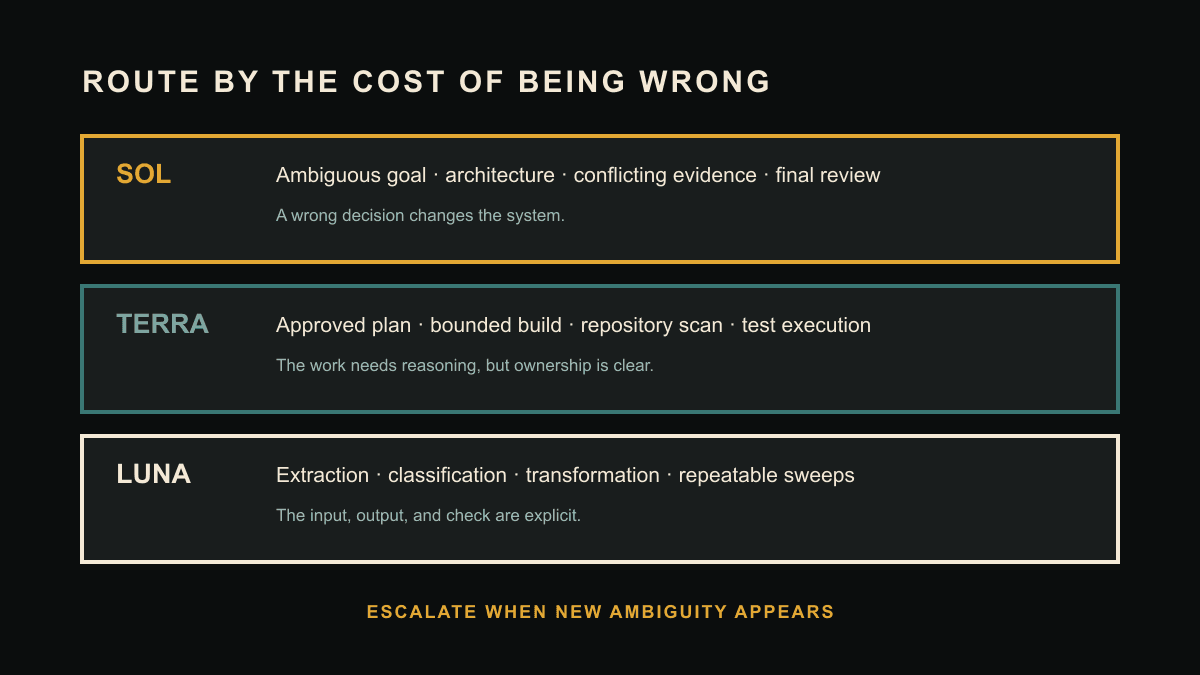
This is not a workaround for a bad model. It is how OpenAI currently describes the family.
Sol is positioned for complex, open-ended, high-value work that needs analysis and judgment. Terra is the everyday workhorse. Luna is for clear, repeatable, high-volume tasks. OpenAI's subagent guidance makes the split even more concrete: keep the main thread focused on requirements, decisions, and final outputs, then send exploration and noisy intermediate work to workers that return distilled results.
As of July 12, 2026, OpenAI estimates that a Plus user may get roughly 15 to 90 local Sol messages, 20 to 110 Terra messages, or 50 to 280 Luna messages in a five-hour window. Those are broad ranges, not promises. Context, reasoning effort, tools, retrieval, caching, and task complexity all change the result.
The point is not that cheap automatically means efficient. A cheap worker that fails three times is expensive. The point is that different jobs have different intelligence requirements.
| Option | Best For | Avoid When | What Goes Wrong |
|---|---|---|---|
| Sol | Ambiguous goals, architecture, decomposition, hard debugging, conflicting evidence, final review, and escalation. | The plan is approved, the task is mechanical, and a mistake is easy to detect and retry. | The control plane gets buried in file edits, logs, and repetitive tool output. |
| Terra | Bounded implementation, repository exploration, test execution, document processing, and work that returns evidence to Sol. | The worker would need to redefine the goal, make a risky architecture call, or own final accountability. | A bounded task quietly becomes a judgment task and the worker keeps going instead of escalating. |
| Luna | Extraction, classification, transformation, structured summaries, and repeatable sweeps with explicit checks. | The task contains hidden product, security, or architecture decisions. | Fast output creates quiet drift because the specification was never as clear as it looked. |
Keep Sol on the control plane
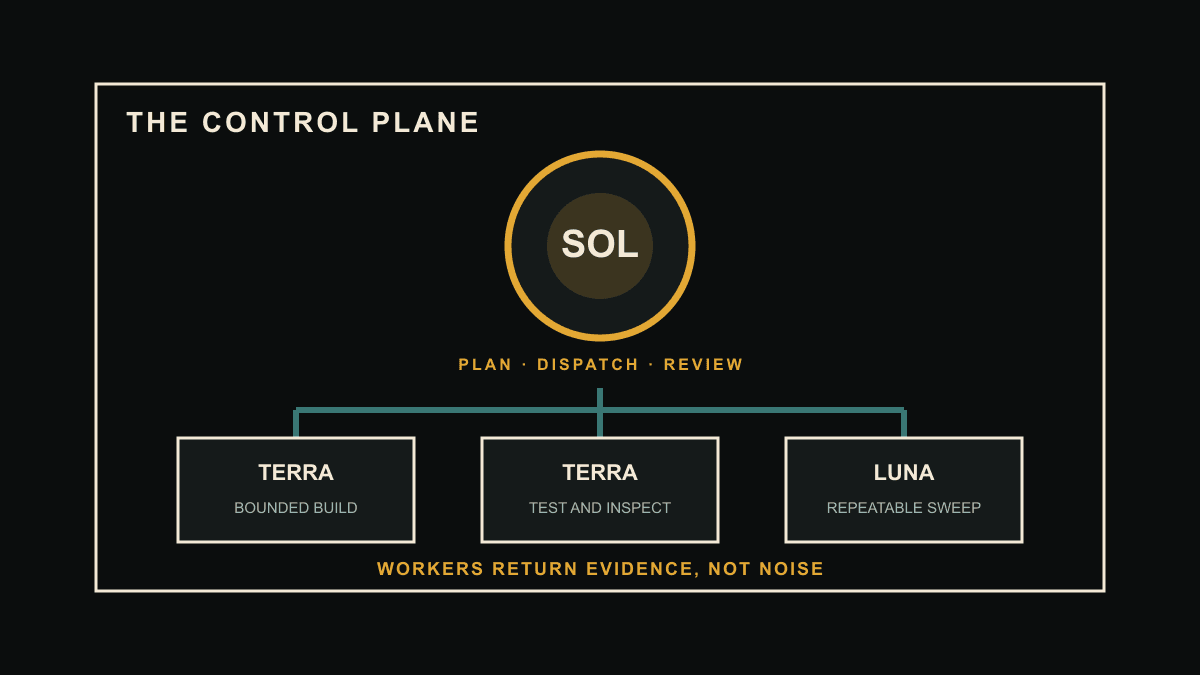
The main Sol session should own the things that get more valuable when context accumulates: the goal, the architecture, the tradeoffs, the task graph, and the definition of done.
It should not own every intermediate artifact. Raw search results, test logs, file inventories, and repeated edits make the main thread look busy while burying the decisions that actually matter.
Inside WarpOS, my agentic operating-system project, I treat the main session as a coordinator with protected context. Workers get narrow assignments. They return a summary, the evidence, the files changed, the checks run, and anything that still feels uncertain. Sol decides whether that proof is enough.
This is the useful split: Sol protects intent, workers absorb churn, and review reconnects the output to the original decision.
A worker needs a dispatch brief, not a wish
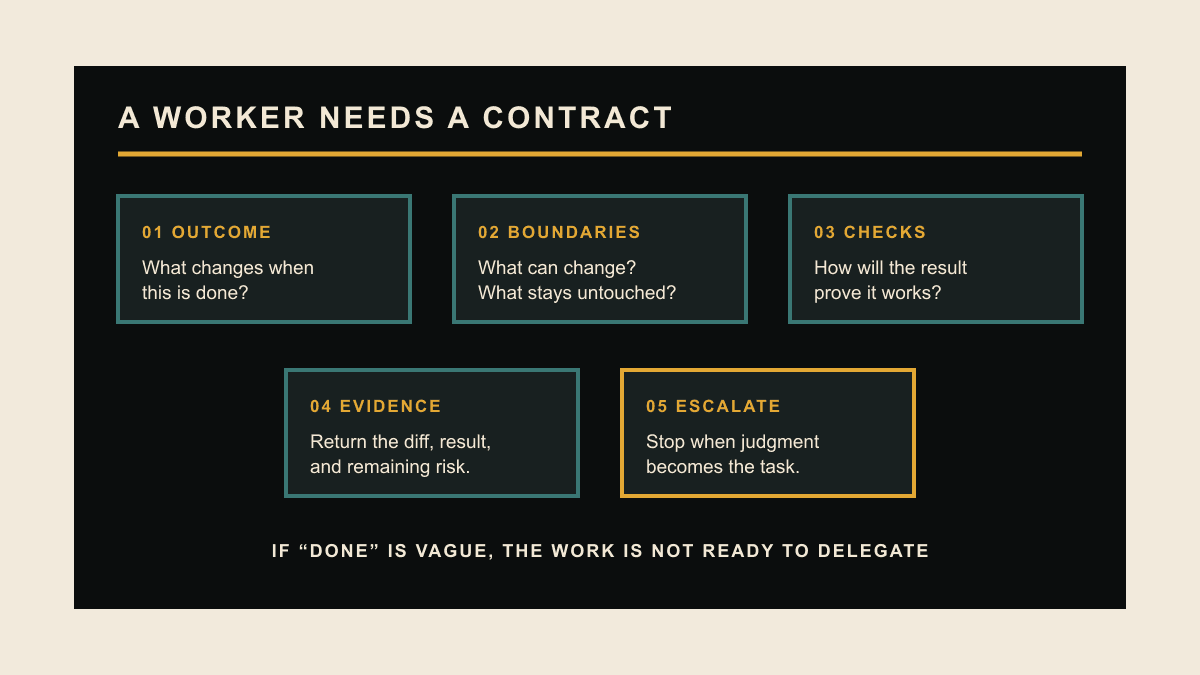
Delegation fails before the worker starts. The planner says something vague like implement the feature, clean up the code, or investigate the problem. Then everyone acts surprised when the worker makes a product decision, rewrites an unrelated file, or returns a wall of confident prose.
A useful dispatch brief is boring. That is why it works. The worker knows what outcome it owns, where it can operate, how the result will be checked, and when it must stop.
If I cannot write these fields, I do not have a worker task yet. I still have a planning problem, which belongs with Sol.
Workers should return evidence, not context pollution
A worker is useful because it keeps intermediate noise out of the main session. That benefit disappears if it pastes every log line, every file it opened, and every discarded idea back into Sol's context.
I want the result in a shape Sol can judge quickly: what changed, why it satisfies the task, what was checked, what failed, and what remains uncertain. The raw details can stay in the worker thread or the repository unless review needs them.
This also makes cheap work safer. A worker cannot hide behind a long answer when the return contract asks for specific evidence. Either the test passed, the diff matches the boundary, and the open risk is named, or it did not finish the task.
Bring the work back when judgment becomes the task
The worker should not prove its value by refusing to stop. Persistence is useful until the task changes underneath it.
A bounded implementation can expose a bad assumption. A repository scan can find two competing architectures. A test can fail because the product requirement is internally inconsistent. At that point, more execution is not progress. Judgment has become the task.
My rule is one well-specified attempt. If the worker fails because the instructions were incomplete, the evidence conflicts, or the safe boundary no longer holds, it escalates. Sol updates the plan or takes the hard part directly, then dispatches the next bounded step.
Test accepted work, not how busy Sol looked
The launch complaints about usage should be taken seriously, but not lazily. Some people reported burning through a five-hour allowance quickly. Some of those reports involved Ultra, which OpenAI explicitly says uses subagents and more tokens. OpenAI product lead Tibo Sottiaux also said the team was changing Sol usage behavior during the rollout. That is market evidence, not a stable benchmark.
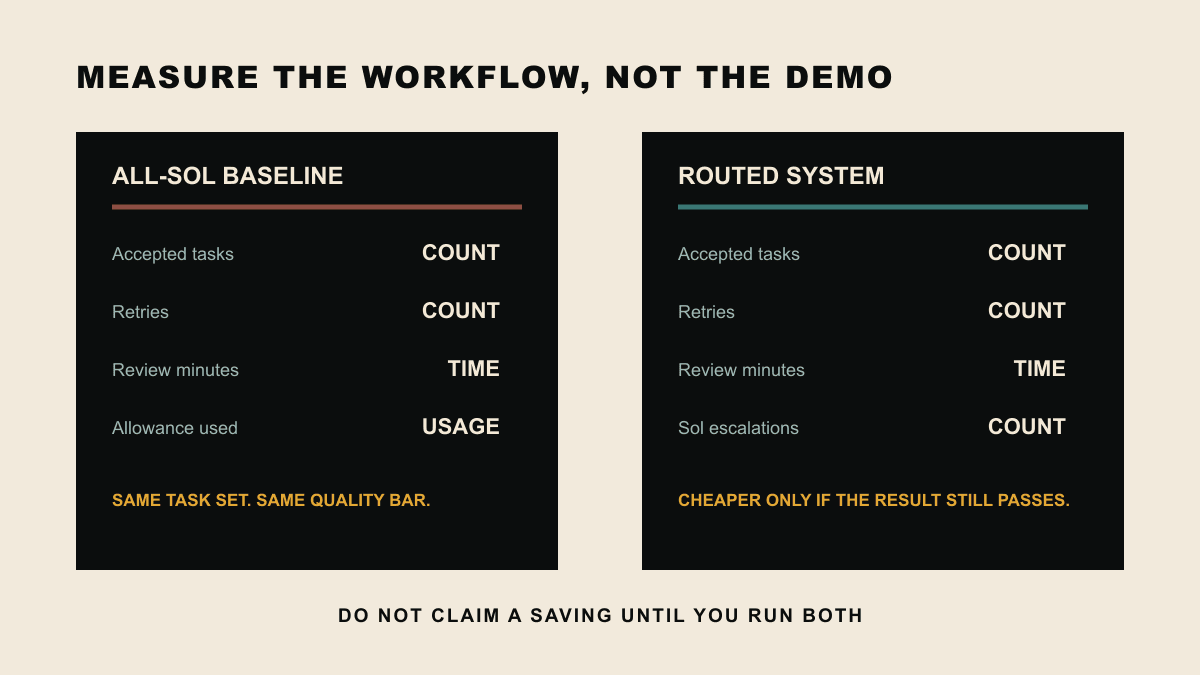
The honest test is to run the same task set twice. In the baseline, let Sol do everything. In the routed version, let Sol plan and review while Terra or Luna handles the bounded work. Keep the acceptance criteria the same.
Then count completed work that you would actually keep. Fewer Sol messages mean nothing if retries and review debt erase the saving. More subagents mean nothing if they create coordination work nobody measured.
Use Sol like a lead, not an intern
Sol should still write code. It should still use tools. It should still take over a task when the risk justifies it. The point is not to keep the strongest model clean by making it useless.
The point is to spend its judgment where judgment compounds.
Let Sol understand the messy request, turn it into a plan, route the work, protect the boundaries, review the proof, and resolve the exceptions. Let workers do the parts that became obvious because Sol did the hard thinking first.
That is how Sol stops eating the workflow and starts running it.
FAQ
Should GPT-5.6 Sol write code?
Yes. Use Sol directly when implementation is ambiguous, risky, tightly coupled to architecture, or difficult to review. Delegate code that has an approved plan, a narrow boundary, and clear checks.
Which work should go to GPT-5.6 Terra?
Use Terra for bounded implementation, repository exploration, test execution, document processing, and parallel work that still needs normal reasoning and tool use.
Which work should go to GPT-5.6 Luna?
Use Luna for explicit, repeatable tasks such as extraction, classification, transformation, structured summaries, and other work with a known recipe and cheap validation.
Do subagents save usage?
Not automatically. Subagents consume their own tokens and add coordination overhead. They are useful when work can be bounded, run independently, and return a result that is cheaper to review than to recreate.
When should a worker escalate back to Sol?
Escalate when the goal becomes ambiguous, evidence conflicts, the safe boundary changes, a check fails for an unexpected reason, or the next step requires architecture, security, product, or integration judgment.
How can I tell whether model routing actually works?
Compare an all-Sol baseline with a routed workflow on the same tasks and acceptance criteria. Measure accepted tasks, retries, review time, escalations, defects, and main-session context growth.
Conclusion
I've seen the usage complaints. I am not dismissing them. I am saying the first thing to inspect is the job Sol was given.
If Sol is doing every bounded task, change the system before you change the subscription. Put Sol on the control plane, give workers contracts, and make evidence the price of coming back into the main thread.
Sources
- OpenAI: Choosing Sol, Terra, and Luna
- OpenAI: Subagents and model choice
- OpenAI: Why subagent workflows help
- OpenAI: Codex pricing and usage limits
- OpenAI API: GPT-5.6 Sol model
- Kimmonismus on X: Sol allowance report
- Jiakai on X: Sol Ultra usage report
- Tibo Sottiaux on X: Sol Medium and Ultra guidance
- Tibo Sottiaux on X: July 12 Sol usage changes
Next move
Want me to audit your AI workflow?
Bring the messy agentic workflow, adoption bottleneck, or product process. I will help map what should happen, where it breaks, and what the system needs to record or review.
Talk about an AI workflowAbout the author

Related articles
Keep going
GPT-5.6 Sol First Impression: The Hype Actually Has Teeth
GPT-5.6 Sol feels surprisingly strong on first use. The catch is speed. The bigger story is that OpenAI finally has a serious answer to Fable 5.
Stop Paying AI To Re-Read The Same Context
Every stale instruction, repeated file, and oversized chat history has a cost. Context management saves tokens by giving the model the right state, not the whole project.
GPT-5.6 Sol vs Terra vs Luna: Give Each Model A Job
GPT-5.6 is a model-family decision, not a leaderboard. Sol, Terra, and Luna should own different jobs inside a serious AI workflow.