Agents
How to Give AI One Clear Source of Truth
More context does not fix disagreement. Save one agreed request, mark what is known and guessed, and stop when the team still conflicts.
Use this when
you need the work to hold up in real use.
Create one agreed product request and decide whether AI work is ready, needs more input, or contains a conflict that must be settled first.
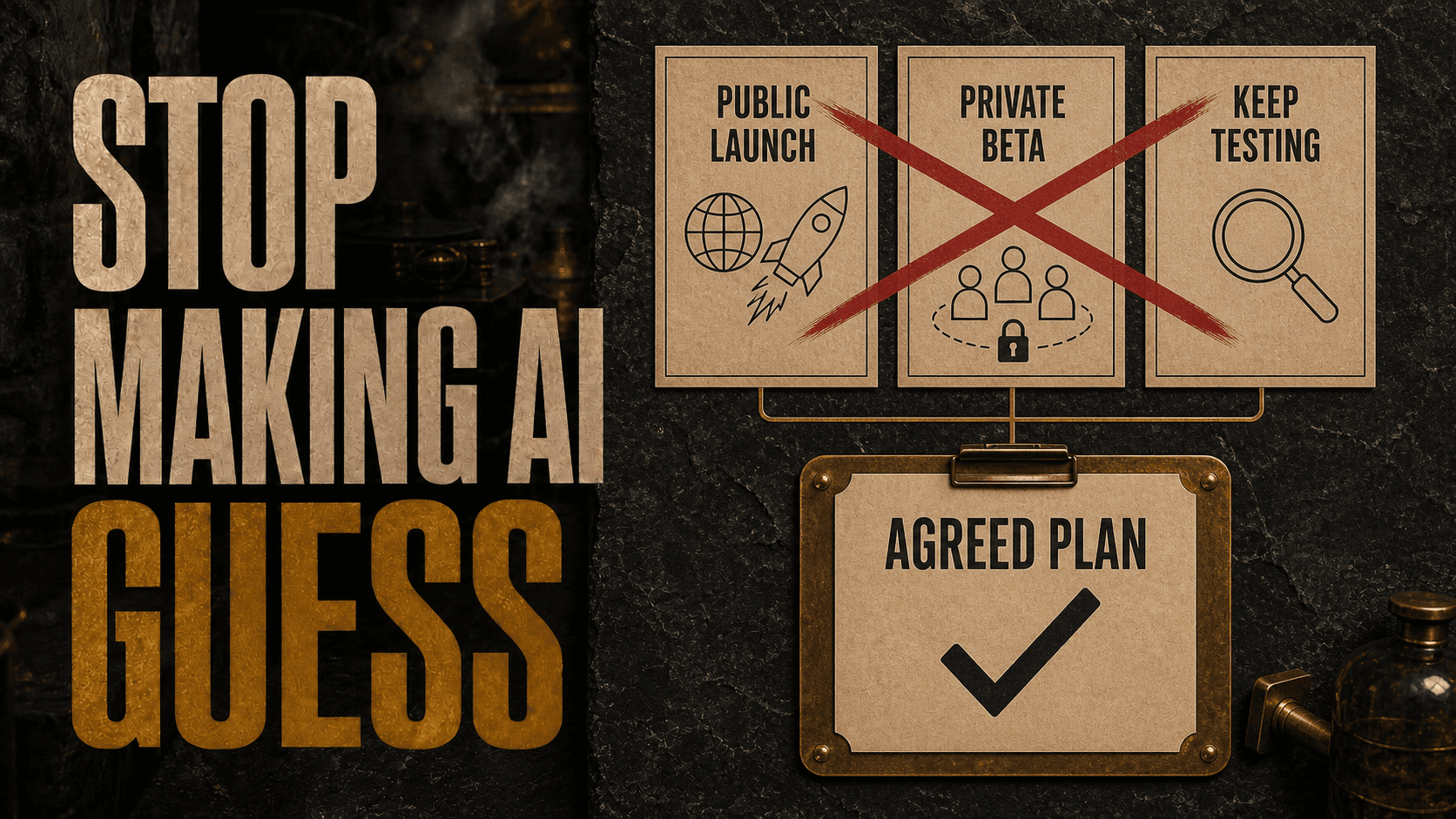
A founder asks AI to plan a public launch. The product lead opens another session and asks for a small test with 20 invited customers. Both plans look sensible. They also describe two different products.
This is not mainly an AI problem. The team never agreed which request was current, so the AI filled the gap with whichever version it saw.
More files will not settle that disagreement. You need one current record that shows the original request, the facts, the guesses, the open questions, the limits, and the person who can decide.
This guide helps you create that record and choose one of three answers: READY, NEEDS_INPUT, or CONFLICT.
Key takeaways
- More context is useful, but more context is not the same as agreement.
- Keep the original request separate from facts, guesses, and later decisions.
- Do not let AI plan when a required answer is missing or two approved versions conflict.
- Give one person ownership of the record and require approval before planning starts.
What does one source of truth mean?
A source of truth is the current record your team agrees to use for the next decision.
It does not mean one person knows everything. It does not mean every old note is wrong. It means the team can point to one place and say, "Use this version until we approve a change."
For AI work, the record should keep four things separate: what someone asked for, what the team knows, what the team is guessing, and what still needs an answer.
Engineers sometimes call this a canonical record. Here, canonical only means the agreed current version. The ordinary idea matters more than the label.
This record is one of the 12 practical parts of an AI building system. It gives later planning, review, proof, and recovery a stable place to begin.
Why does more context not fix disagreement?
A folder can hold every brief, chat, research note, and meeting recap. That makes the material easier to find. It does not tell AI which version won.
Current AI products can keep related chats, files, instructions, and history together. That is useful. It still leaves a product decision for your team: which request is current, and which claims are facts rather than guesses?
If two files disagree, AI may choose the newer file, the longer file, or the instruction that sounds more certain. A polished answer can hide that choice.
Your record should not hide disagreement. It should name the conflict and stop the work until the owner settles it.
What should the agreed record contain?
Use a short record. The goal is not to document the whole company. The goal is to give this piece of work a safe starting point.
The table below uses a checkout example. A team wants customers to save a draft checkout and finish later.
| Part | What to write | Checkout example |
|---|---|---|
| Original request | Keep the request in the requester's own words. | Let customers save a draft checkout and finish it later. |
| Wanted result | Name the change you hope to see. | More invited beta users finish checkout without support help. |
| People affected | Name the first users or team. | Twenty invited beta customers on the web app. |
| Known facts | Write each important fact with its source. | Seven interview notes mention returning to an unfinished checkout. |
| Assumptions | Label what you believe but have not proved. | A saved draft will remove the main reason people stop. |
| Open questions | Keep unanswered questions visible. | How long should a draft remain available? |
| Scope and non-goals | Say what this version includes and excludes. | Web beta only. No public launch, mobile app, or customer email. |
| Owner and approval limit | Name who settles questions and what AI may do first. | The product lead decides. AI may draft a plan but may not publish or contact customers. |
How do you decide if the request is ready?
Do not ask whether the record looks professional. Ask whether the next person or AI can plan without inventing an important answer.
Use three decisions. Each one should include a reason and one next action.
| Decision | Use it when | What happens next |
|---|---|---|
| READY | Required answers are present, important facts have sources, and no important conflict is open. | The owner approves the record. Planning may begin from this version. |
| NEEDS_INPUT | A required answer or source is missing, but the team does not disagree about the answer yet. | Name the missing item, assign an owner, and check again after it is added. |
| CONFLICT | Two requests, facts, limits, or approvals disagree in a way that changes the plan. | Stop. Ask the named owner to choose or reconcile the versions. |
What happened in the small readiness test?
I ran a small local test with three made-up checkout records. It did not call a model, use the network, or touch a real product.
The check looked for five required answers, sources for important facts, and any open conflict. The point was not to prove production safety. It was to prove that missing and conflicting input did not quietly become a plan.
| Record | Observed decision | Why |
|---|---|---|
| Complete beta request | READY | The result, audience, owner, approval limit, and sourced fact were present. |
| Missing owner and unsupported claim | NEEDS_INPUT | The check named both missing items and stopped planning. |
| Public launch and invited beta both approved | CONFLICT | The check asked the owner to reconcile the two launch versions. |
What did WarpOS teach me about starting truth?
I ran into this problem while building WarpOS, my agentic operating-system project. A rough request could not safely become tickets and build work in one jump.
At the frozen public version I reviewed, its starting flow kept the raw intake separate, created a set of product records, and left visible needs-input markers when a fact was missing. A later plan record kept the original request, the interpreted goal, the wanted result, assumptions, questions, scope, non-goals, and approval limits together.
That structure is useful because a missing answer stays visible. It is also only partial proof. A form can preserve a bad interpretation perfectly. A check can require a source without proving that the source is correct.
The lesson is not to trust the form. The lesson is to make the team's current belief inspectable, keep uncertainty visible, and give a person the final say before planning.
What happens when the request changes?
A source of truth is current, not frozen forever. Product work changes because you learn.
Do not rewrite the original request until nobody can see what changed. Keep the raw request. Add the new decision, its owner, its date, its reason, and the parts of the plan that may now be wrong.
Mark the older agreed record as replaced and point to the new one. Engineers may call this superseding a record. It simply means, "Do not use the old version; use this named version instead."
If a change affects the audience, promised result, scope, fact, or approval limit, run the readiness decision again before work continues.
What can your team do this week?
Pick one request that is about to become AI-assisted work. Do not start with your whole roadmap.
Save the original request. Fill the eight parts from this article. Put facts and assumptions in different lists. Name the owner. Then return READY, NEEDS_INPUT, or CONFLICT with one reason and one next action.
If the result is not READY, stopping is the useful outcome. You found uncertainty before it became faster wrong work.
FAQ
Is a source of truth just one big context document?
No. A context folder can hold useful material. The source of truth is the current agreed record that says which request, facts, assumptions, limits, and open questions the team will use next.
Can AI create the source-of-truth record?
AI can organize the material and point out missing or conflicting input. A named person still needs to correct the record, settle product choices, and approve the version used for planning.
What if a fact has no source?
Label it as an assumption or return NEEDS_INPUT. Do not make it look like a confirmed fact because it appeared in a confident message.
Should the record change during the project?
Yes, when the team learns something important. Save the reason, owner, date, and affected work. Mark the old version as replaced and run the readiness check again.
What is the smallest version I can use?
Keep the original request, wanted result, people affected, known facts and sources, assumptions, open questions, scope, owner, and approval limit. A simple shared document is enough to start.
Conclusion
AI does not need every file your company owns. It needs one agreed starting point for the work in front of it.
Keep the request, facts, guesses, questions, limits, and owner visible. If something important is missing, return NEEDS_INPUT. If two versions disagree, return CONFLICT. Planning begins only when the owner can honestly say READY.
That small stop rule is how you keep fast AI work attached to a real product decision.
Sources
Next move
Have one workflow that should move faster?
Bring the process, the bottleneck, and the outcome. I can help diagnose it, design the human and AI boundary, build the smallest working MVP, and measure whether it deserves another iteration.
Start with one workflowAbout the author

Related articles
Keep going
What an AI Building System Needs: 12 Practical Parts
A plain-language guide to the 12 parts that keep AI-assisted work accurate, reviewable, and recoverable, backed by a frozen WarpOS audit.
How to Make AI Work Pick Up Where It Left Off
A practical guide to recoverable AI work, with a portable resume packet, a hard-kill experiment, and evidence from a frozen WarpOS audit.
How to Change AI Project Requirements Without Losing the Thread
A plain guide to changing AI project requirements without letting old tasks, product behavior, or checks quietly keep running.